



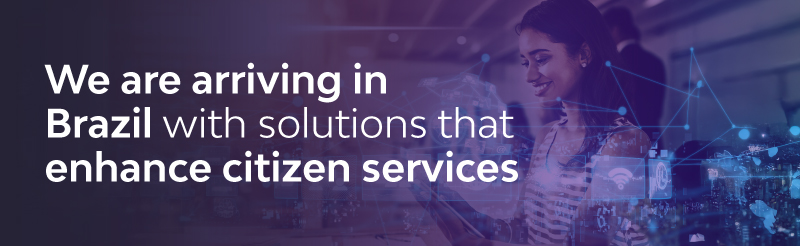
With artificial intelligence, we are driving the digital transformation of Brazil’s government.
From Colombia, and with more than 30 years of operation, Quipux is making a significant contribution to the digital transformation of the public sector in Brazil. Today, we work alongside the governments of the states of Rio de Janeiro, Minas Gerais, Ceará and Paraná, as well as the City of São Paulo, supporting the modernization of citizen services through technology platforms powered by artificial intelligence.
Our model already reaches a potential population of more than 75 million people, and by 2026 we project to support the dematerialization of over 60 million procedures, reducing time, costs, and access gaps for citizens.
Citizen-centered autonomous operations
The innovation we bring to Brazil is grounded in the concept of autonomous operations, where intelligent algorithms support the management of large citizen service centers that execute more than 100,000 procedures every day.
It all begins with the creation of a single service channel that brings together government services at the state, municipal, and even federal levels into one integrated digital ecosystem. This model is built on an essential principle: simplifying citizens’ lives.
We integrate procedures related to taxation, health, land registry, transportation, passports, pensions, social benefits, unemployment subsidies, public transport cards, among many others, through digital channels managed with artificial intelligence, advanced analytics, chatbots, robotic process automation (RPA), mathematical models, and virtual citizen authentication.
Measurable, large-scale impact
The results of this integration are tangible and high-impact:

Government Entity | Different procedures integrated | Annual transaction volume (millions) | Population (millions) |
Rio de Janeiro (State) | 316 | 11.2 | 17.2 |
Minas Gerais (State) | 422 | 6.6 | 21.4 |
Parana (State) | 242 | 11.9 | 11.8 |
São Paulo (City – Metropolitan Area) | 150 | 13.2 | 25.3 |
This dematerialization process requires the integration of multiple existing government platforms, developed by different vendors or internal teams, while ensuring interoperability across systems and databases. In addition, we address both front-office and back-office operations, covering physical service points, digital channels, and hybrid service models.

Artificial intelligence for real-time decision-making
Our technology also enables the management of large volumes of data associated with citizen services through advanced probabilistic and stochastic models, characteristic of statistical artificial intelligence. These analyze information in real time to optimize the allocation of appointments and resources, both in physical locations and virtual channels.
We complement this capability with situation rooms, where operational indicators are consolidated into an integrated view that supports accurate, timely, and evidence-based decisions.
More efficient governments and sustainable cities
With these solutions, Brazil’s government is moving toward more agile, modern, and transparent citizen services, with broader coverage and 24/7 availability. At the same time, the dematerialization of procedures is being strengthened as a key pillar for building more sustainable cities, reducing pollutant gas emissions by minimizing unnecessary travel, optimizing resources, and promoting environmentally responsible and efficient public management.
At Quipux, we remain convinced that technology, when placed at the service of people, is a powerful tool to transform public administration and improve the lives of millions of citizens.
